For most of human history, the Sun was treated as an eternal fire, a divine lamp fixed in the sky whose light simply was. Its daily rise and fall shaped agriculture, religion, and timekeeping, yet no one knew why it shone at all. Even in the 19th century, when science began to seriously tackle the question, the answer remained unsettlingly incomplete. Chemical burning could not explain the Sun’s brilliance, and gravitational contraction—slowly shrinking under its own weight—would only keep it glowing for a few million years. That posed a disturbing contradiction: Earth’s geology and biology clearly showed a planet far older than that. Something deeper had to be happening inside the Sun.
The solution came only when scientists began to understand the atom itself. At the dawn of the 20th century, physics revealed that atoms were not indivisible but contained enormous stores of energy locked inside their nuclei. This realization hinted at a power source far beyond ordinary combustion. The missing link arrived with Einstein’s famous insight that mass and energy are interchangeable, summarized by E = mc². It suggested that even a tiny loss of mass could release staggering amounts of energy, enough to fuel a star for billions of years.
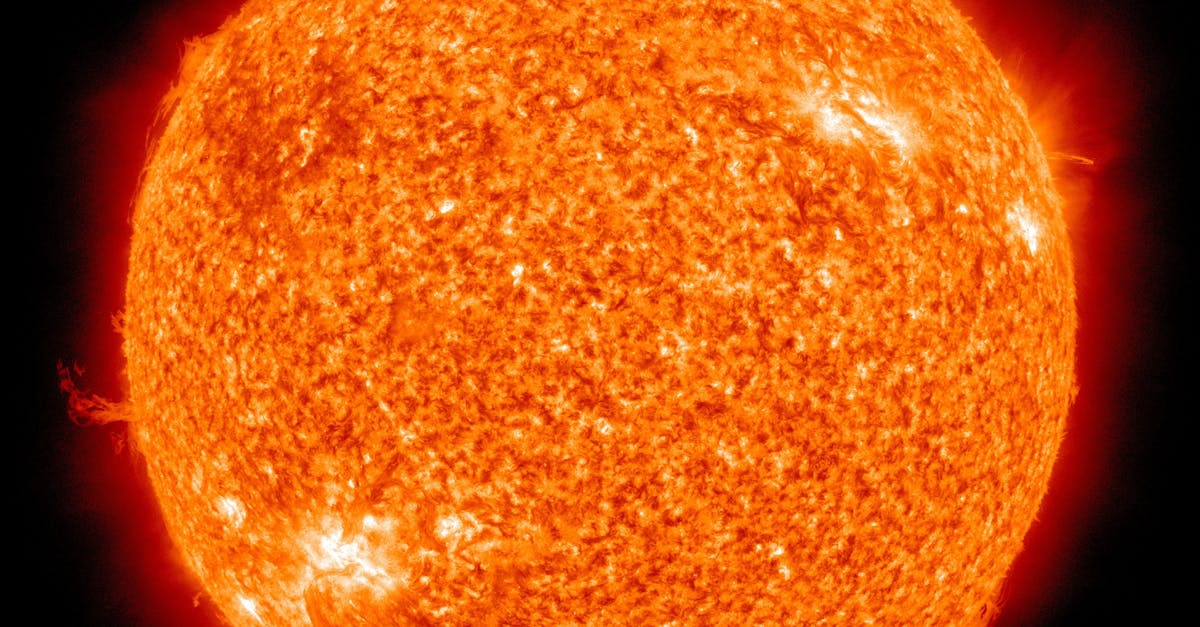
The breakthrough explanation of how this happens inside the Sun was worked out in the 1930s by Hans Bethe. He showed that stars shine because of nuclear fusion, a process in which lightweight atomic nuclei combine to form heavier ones. In the Sun’s core, immense pressure and temperatures exceeding 15 million degrees Celsius force hydrogen nuclei—single protons—to fuse together. Through a series of reactions now known as the proton–proton chain, hydrogen is slowly converted into helium. In each step, a tiny amount of mass disappears, re-emerging as energy that eventually escapes as sunlight.
What makes this process remarkable is not just its power, but its stability. Fusion is extremely sensitive to temperature: if the Sun’s core heats up slightly, fusion speeds up, increasing outward pressure and causing the core to expand and cool. If fusion slows, gravity compresses the core, raising the temperature again. This self-regulating balance has allowed the Sun to shine steadily for about 4.6 billion years and will keep it glowing for roughly the same amount of time into the future.
An often-overlooked detail is just how slow fusion really is. Despite the Sun’s immense output, each individual proton in the core can wander for billions of years before it finally participates in a fusion reaction. The Sun is not an explosive furnace but a finely tuned energy generator, operating with extraordinary patience. This slowness is the reason stars like our Sun are long-lived and why complex life has had time to evolve on Earth.
Another easily forgotten fact is that the light we see today began its journey long before humans existed. Energy released by fusion starts as high-energy gamma rays that bounce around inside the Sun, scattering off particles again and again. It can take hundreds of thousands of years for this energy to reach the surface, where it finally escapes as visible light. When sunlight warms your skin, you are feeling the delayed echo of reactions that happened deep in the Sun’s core long before recorded history.
Understanding why the Sun shines did more than solve an astronomical puzzle. It unified physics across scales, linking subatomic particles to the life cycles of stars and planets. It also revealed that the same process powering our Sun fuels countless stars across the universe, turning hydrogen into helium and, over time, creating the heavier elements essential for planets and life. In that sense, stellar fusion is not just the reason the Sun shines—it is the reason we exist at all.