Few scientific discoveries have carried consequences as dramatic and far-reaching as nuclear fission. What began as an abstract attempt to understand the structure of matter ended up reshaping global politics, redefining warfare, and offering humanity a new and controversial source of energy. The story of nuclear fission is not only about physics, but also about how quickly knowledge can escape the laboratory and transform the world.
At the start of the 20th century, atoms were still thought of as nearly indivisible building blocks. That idea began to crack as scientists explored radioactivity and the strange behavior of atomic nuclei. The decisive moment came in 1938, when experiments led by Otto Hahn showed that bombarding uranium with neutrons produced lighter elements. The results were puzzling until Lise Meitner, working with her nephew Otto Frisch, realized what had happened: the uranium nucleus had split into two smaller nuclei. In that split, a small amount of mass vanished, converted into energy according to Einstein’s famous equation, E = mc². Nuclear fission had been identified.
What made fission extraordinary was not just that atoms could be split, but that the process released enormous energy and additional neutrons. Those neutrons could trigger further fissions, creating a chain reaction. Under controlled conditions, this chain reaction could be slowed and stabilized. Uncontrolled, it could grow explosively. Almost immediately, scientists understood both possibilities.
In the late 1930s and early 1940s, fears that Nazi Germany might weaponize fission pushed research forward at unprecedented speed. This culminated in the Manhattan Project, a massive secret effort involving thousands of scientists and engineers. Figures like Enrico Fermi played key roles, with Fermi overseeing the first controlled nuclear chain reaction in 1942 beneath the University of Chicago. That moment proved that nuclear energy could be harnessed deliberately rather than violently.
The war, however, gave priority to the violent application. In August 1945, atomic bombs were dropped on Hiroshima and Nagasaki, instantly killing tens of thousands of people and leaving long-term radiation effects that persisted for decades. These events marked a turning point in human history. Warfare was no longer limited by conventional explosives; a single device could devastate an entire city. Nuclear fission had permanently altered the balance of power and introduced the concept of global annihilation.
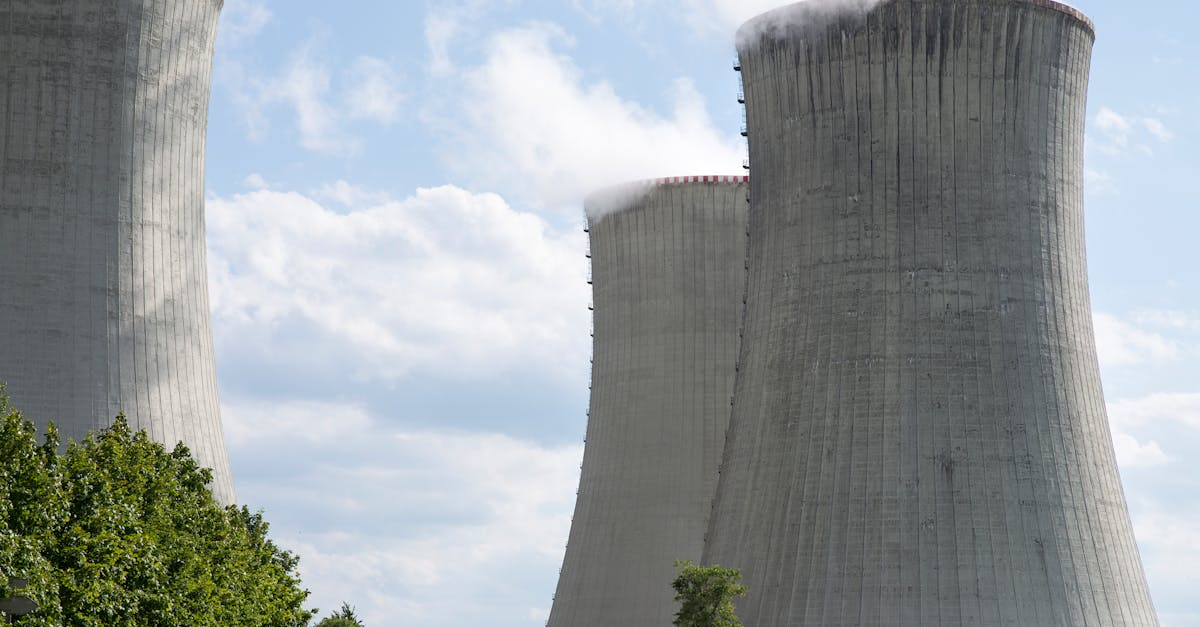
After the war, attention shifted toward peaceful uses of fission. Nuclear reactors were developed to produce electricity by carefully controlling chain reactions, using heat to generate steam and drive turbines. One little-known detail is that nuclear plants do not burn fuel in the traditional sense; they rely on precise engineering and physics to keep the reaction stable. The energy density of nuclear fuel is astonishing: a small amount of uranium can produce as much energy as thousands of tons of coal, with no carbon dioxide released during operation.
Yet the legacy of fission remains deeply conflicted. Concerns about radioactive waste, nuclear accidents, and weapons proliferation have never disappeared. Events like reactor meltdowns reminded the public that while nuclear fission is controllable, it is never trivial. At the same time, as the world searches for low-carbon energy sources, nuclear power continues to be reconsidered as a tool against climate change.
Nuclear fission stands as a powerful example of how a single scientific insight can reshape civilization. By splitting the atom, humanity unlocked both a new source of energy and a new scale of destruction, forcing society to confront questions of responsibility that science alone cannot answer.